


What Is Surgical Tele-Mentoring? How It's Solving the OR's Expert Access Problem
An estimated 5 billion people worldwide lack adequate access to surgical care, and low- and middle-income countries need an additional 143 million life-saving procedures every year (PMC, 2026 systematic review). Even in well-resourced health systems, rural and regional hospitals routinely face the same underlying constraint: no immediate access to subspecialty expertise when a case gets complicated. This is precisely the gap surgical tele-mentoring (remote surgical consultation) is designed to close.
This article breaks down what tele-mentoring is, how it differs from telesurgery, what technical infrastructure it requires, and what CureVision's CureLink platform brings to hospitals adopting it.
What Is Tele-Mentoring? Not to Be Confused With Telesurgery
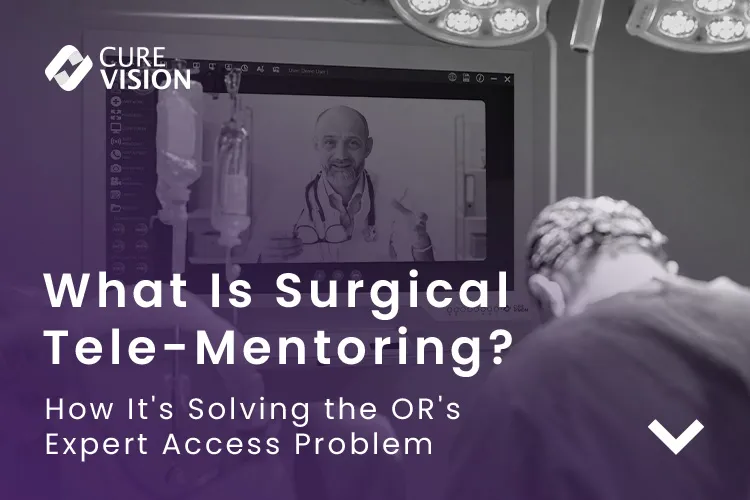
Surgical tele-mentoring is the practice of an off-site expert surgeon providing real-time guidance to an operating room team via live video and audio, without controlling any instruments remotely. According to a 2026 review from the American College of Surgeons, the defining distinction from telesurgery is this: decision-making authority and accountability always remain with the surgeon physically present in the OR. The remote mentor offers visual and verbal guidance only — they never operate the equipment.
This distinction matters for both regulatory compliance and patient safety, because tele-mentoring is positioned as a layer that augments the existing surgical team's capability — not a replacement for it.
Why Now? Three Trends Driving Adoption
1. Uneven access to subspecialty expertise. Surgeons in rural and regional hospitals need on-demand expert input for rare or complex cases. Research shows rural surgeons view tele-mentoring favorably for difficult cases and for acquiring new skills (Springer, Surgical Endoscopy).
2. 5G and low-latency connectivity. 5G networks now deliver sub-10-millisecond latency and up to 1 Gbps of bandwidth, making real-time surgical guidance technically scalable in ways that weren't possible a few years ago.
3. Maturing, standardized protocols. The ACS's 2026 assessment lays out concrete protocols for safe, scalable tele-mentoring: licensed, board-certified mentors, formal inter-institutional agreements, and secure, compliant video platforms. This maturity is what allows hospitals to move tele-mentoring from a pilot project to an operational standard.
What Technical Infrastructure Does Surgical Tele-Mentoring Require?
An effective tele-mentoring setup needs, at minimum:
- High-definition video streaming: Full HD or 4K quality so the surgical field is clearly visible
- Low latency: Millisecond-level delay so real-time guidance is actually actionable
- Telestration: The ability for the remote mentor to annotate directly on the live image
- Secure, compliant connectivity: GDPR-aligned data protection along with cross-institutional licensing and credentialing
- PACS/HIS integration: Automatic transfer of recordings into the hospital's information and imaging systems
Meeting all of these requirements through a single platform — rather than stitching together multiple vendors — is what determines both cost and technical reliability for hospitals.
CureVision's Answer: Connect Your OR to Any Expert, Anywhere, With CureLink
At the center of CureVision's OR Integration System is CureLink, built around the principle: “Record. Transfer. Collaborate. From One Platform.”
CureLink's capabilities relevant to tele-mentoring include:
- Live telemedicine streaming: Connects your OR to a remote consultant or training center anywhere in the world, in real time, without interrupting the procedure.
- 4K and Full HD options: DICOM-compliant D55/D65/D93 color calibration for diagnostic-grade image quality.
- MDR Class I certification and IEC 60601-1 compliance: Built to OR-grade reliability standards.
- Automatic PACS/HIS integration: Recordings and images flow directly into existing hospital systems.
- Recording and archiving: Documents surgical video for resident training and case review.
- GP-446 (46" Full HD) and GP-449 (49" 4K) wall-mount configurations: Flexible installation options for different OR layouts.
Because CureLink runs on the same ecosystem as CureConsole (OR console) and CureIQ (AI-powered surgical assistant), CureVision's “One vendor. Every layer of the OR” approach means hospitals get end-to-end OR integration under a single support contract — without compatibility issues between components.
Concrete Benefits for Hospitals
- Equitable access to expertise: Hospitals with limited subspecialty resources can consult top specialists regardless of geography.
- Accelerated training: Live streaming and recording support resident training, surgical education programs, and remote proctoring.
- Standardized quality of care: Intra-institutional mentoring improves procedural consistency across departments or sites.
- Surgeon confidence and patient safety: Instant access to a second expert opinion in difficult cases strengthens procedural consistency.
The four implementation models the ACS outlines — intra-institutional standardization, extra-institutional expert consultation, real-time intraoperative guidance, and large-audience teleteaching — can all be configured flexibly on CureLink's infrastructure, scaled to a hospital's size and needs.
Conclusion: Tele-Mentoring Is No Longer Optional — It's Becoming the Standard
Surgical tele-mentoring is now an evidence-backed transformation that reduces inequities in expert access, accelerates training, and strengthens patient safety. With the right infrastructure, it doesn't have to be added complexity — it can be a natural extension of the OR itself.
CureVision's CureLink platform connects your operating room to any expert, anywhere, through one integrated system.
Contact the CureVision team to see how tele-mentoring infrastructure could work in your OR, and request a free demo.